Showing posts with label coffee. Show all posts

Thursday, 26 May 2011

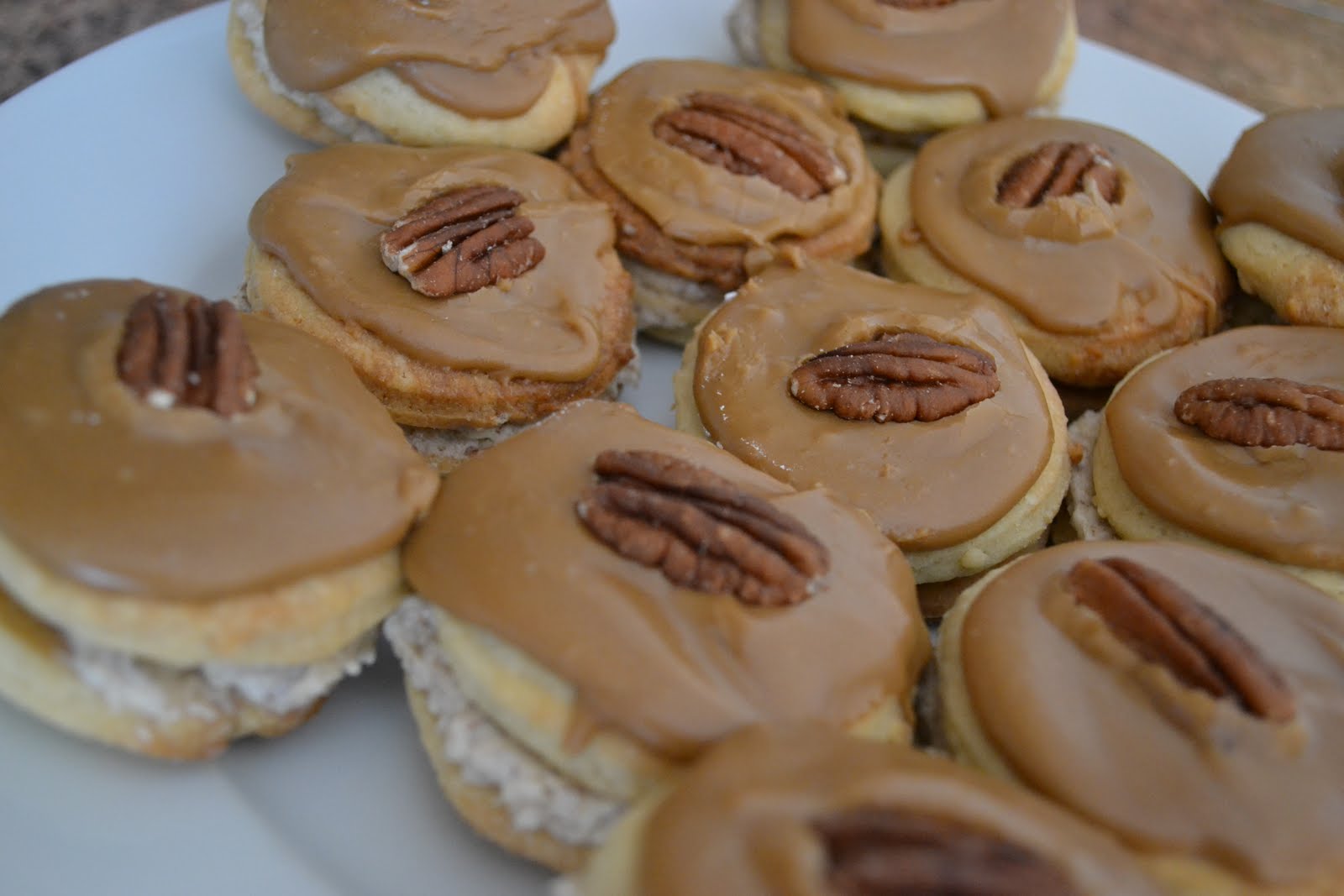
Coffee and pecan biscuits

American readers are probably expecting something very different because of the word 'biscuit', but your understanding of the word is somewhat different from ours. To you, this recipe is probably better described as 'cookies'.

Yet another recipe cut from the pages of some or other magazine. I certainly seem to have read more magazines in my younger days than I do now. Mind you, the big selling magazines around these days are all gossip-and-celebrity, and I have no great interest in that sphere.

Oven temperature
180C

Ingredients

Biscuits
220g flour
125g butter, cubed
60ml sugar
1 egg, lightly beaten
5ml vanilla extract

Pecan cream
60g butter
60ml icing sugar, sifted
80g pecan nuts, finely chopped (I used a food processor)
10ml milk

Coffee icing
375ml icing sugar, sifted
5ml butter at room temperature
15ml instant coffee powder
15ml boiling water
20ml milk

Method
Biscuits
Cut with a biscuit cutter
  • Sift flour into a mixing bowl and rub in butter until you have a mixture resembling fine breadcrumbs.
  • Add sugar, egg and vanilla extract and mix to form a soft dough.
  • Roll out on a lightly floured surface to about 5mm thickness. I do this directly on my counter tops. And if you don't have a rolling pin, use a clean wine bottle (you can even drink the wine first, if you like!).
  • Cut out rounds using a 60mm plain biscuit cutter. If you don't have one, use a clean napkin ring or something along those lines. I used the top end of my cookie gun. You should get about 26-30 biscuits. Make sure you have an even number.
  • Place on a lightly greased baking tray and bake for 10 minutes until light golden brown.
  • Cool on wire cooling racks while you get on with other things.
Pecan cream
  • Cream butter until light and fluffy.
  • Add icing sugar and beat well.
  • Add chopped pecan nuts and milk and mix well.
  • When the biscuits are cool (and not a moment before, or it won't work), spread this over half the biscuits and then pop another biscuit on top to make a sandwich. You can afford to be pretty lavish with this, there is a fair amount of it.
  • Refrigerate for 30 minutes while you get on with the coffee icing.
Coffee icing
  • Place icing sugar, butter and milk into the top of a double boiler over medium heat. Don't fret, I don't have one either, so I balance a smallish Pyrex dish on top of a saucepan. The handles of the Pyrex dish are wide enough so that it doesn't fall into the saucepan. There should be enough boiling water in the saucepan so that the bottom of the Pyrex dish is just in the water, but not so much that the water slops over the edge of the Pyrex into the icing sugar.
  • Dissolve the coffee in the 15ml of boiling water and add to the mixture.
  • Stir the mixture over simmering water until it is completely smooth.
  • Spread over the top of each biscuit. Once again, you can afford to be generous, here. This icing will set quite quickly, so I work directly out of the 'double boiler' as I ice the biscuits.
  • Decorate each one with half a pecan, or a glace cherry or whatever takes your fancy. This is of course an entirely optional step.
Yummilicious!

Thursday, 17 February 2011

Milk tart


This is very much an Afrikaans tradition, although it bears some resemblance to an English custard tart. Of course, there are myriad different ways of making it, and everybody's Granny's recipe is 'the best ever'. Some of them involve baking the crust and filling together in the oven, some are crustless, some use a biscuit base.... the variations are endless. In this recipe, the crust is baked blind, and the custard prepared on the hob.

This recipe came from my sister-in-law, Ann, and has become one of my signature dishes. The crust is so delicious, I could eat it without the filling! In fact, I use this crust recipe any time I need a shortcrust pie base, omitting the sugar for savoury dishes.

Oven temperature
180C

Ingredients
Crust
250ml plain flour
20ml sugar
100g butter, melted
Pinch salt

Filling
500ml milk
30ml butter
2 eggs
60ml sugar
30ml cornflour
2.5ml almond essence (and this is the critical factor, for me!)
Ground cinnamon. Lots of ground cinnamon.

Method
Poke it full of holes...
  • Make the crust first. Sift the dry ingredients together.
  • Stir in the melted butter.
  • Press into a pie plate and prick it all over with a fork.
  • Bake for about 10-12 minutes until turning golden.
  • Set aside to cool.
  • While the crust is cooling, or once it has already cooled, you can begin on the filling.
  • Gently heat the milk, sugar and butter together until the sugar has dissolved. Leave it on the hob for now. You will come back to it.
  • Mix the cornflour with a little cold milk.
  • Beat the eggs and add the cornflour mixture.
  • Bring the warm milk mixture on the hob up to the boil, taking care not to scald the milk.
  • Add the cornflour/egg mixture, stirring gently and taking care not to set the eggs as you pour. I find this works best if I pour a little of the hot mixture into the eggs first to raise the temperature, and then add that back into the saucepan.
  • Keep stirring until the sauce thickens, and it just reaches boiling point (signified by the occasional, large bubble that 'gloops' up to the surface).
  • Remove from the heat and add the essence. It is very easy to forget this step. Don't. It's what makes all the difference.
  • Pour into the pie crust.
  • Sprinkle liberally with ground cinnamon. Leave to cool.
  • Serve as a dessert or with tea/coffee.

Friday, 11 February 2011

Tres leches cupcakes

This Christmas past, one of my Facebook friends shared a picture of some tres leches cupcakes he had made with his family. I was intrigued, since I have (just) enough Spanish to figure out that 'tres leches' translates to 'three milks'. He told me a bit about them and I decided they weren't a million miles away from the very first recipe I shared on this blog. They sounded rather decadent and sweet enough to meet the approval of my sugar-mad husband and sons.

So I found a recipe and gave them a whirl. They aren't difficult, but they are a bit of a faff, so don't try them if you're in a hurry.

They were utterly delicious, very sweet, and com-puh-letely decadent. Dieters need not apply. Fortunately for those of you who care about these things, there is still nearly a month before the beginning of Lent! Oh... and also not suitable for those with a dairy intolerance (unless there are non-dairy equivalents for all tres of the leches). Sorry Catherine.

You will need waxed cupcake cups (about 24) and muffin pans. Place a cupcake case into each muffin space.

Oven temperature
180C

Ingredients
6 large eggs, separated

1ml baking powder
1ml salt
250ml sugar
125g butter, melted and cooled
250ml plain (cake) flour
175ml evaporated milk
125ml cream
175ml sweetened condensed milk
Whipped cream (optional)
Ground cinnamon

Method
  • Beat the egg whites, baking powder and salt until it is stiff enough for you to be able to mould it into soft peaks with the beater blades (not quite the stiff peaks needed for meringues).
  • Add the yolks and the sugar and mix until creamy - this shouldn't take more than a minute. From this point on, it's probably best to set aside the electric beater and work with a wooden spoon or spatula.
  • Fold the butter in gently.
  • Blend in the flour, a little at a time.
  • Half-fill each of the cupcake cake cases - you're going to need a little space later, so don't overfill them.
  • Bake for about 20-25 minutes (adjust if you have a fan-assisted oven).
  • While the cupcakes are baking, mix your milks together. You might find this easier if you warm them slightly, but don't let them come anywhere near boiling point.
  • Remove your cupcakes from the oven and poke them full of holes using a skewer of some description (I used a metal meat skewer, which worked fine. I found some recipes that suggested tooth picks, but I found those too thin).
  • Pour a little of the milk mixture over each cupcake. It will soak in. Repeat until all the milk has been used up. You may have to wait a little while between repeats, to let the milk soak in.
  • Leave them to cool.
  • Top with whipped cream, if you're going that route, and a sprinkling of ground cinnamon.
  • Serve as a dessert or with coffee.

Notes:
  • I reckon you could probably do this just as well with a cupcake recipe that calls for fewer eggs and more baking powder. That would certainly make it easier on the pocket!
  • You could also try this with a cupcake recipe that involves cocoa powder - I suspect that would be heavenly!
  • Being married to a Swede, I have noticed that they tend to use cardamom where I might use cinnamon, and it tastes absolutely wonderful, so you might try ground cardamom over the top as an alternative. Nutmeg would probably also work, if you prefer that.

Thursday, 20 January 2011

Robyn's health rusks


This recipe was given to me many years ago by my sister, Robyn.

In the UK, the word 'rusk' tends to conjure up images of an oversized tea biscuit given to teething babies. In South Africa, a rusk is an altogether different thing, enjoyed with (and dunked in) coffee.

During my teens, my extended family often went en masse on holiday to the Drakensburg mountains during the winter, and I have fond memories of rusks with coffee for breakfast on those freezing (no central heating in South Africa) mornings before heading off on a hike. If you really want to be decadent, you sweeten the coffee with condensed milk. Now that really takes me back!

Perhaps it would be best for non-South Africans to relate to these rusks more in the way they would relate to biscotti. In fact, the Afrikaans word for rusk is 'beskuit', so there is probably some shared heritage somewhere along the line.

Apparently the origin of the word 'biscuit/biscotti' (which, strictly speaking, is what 'beskuit' means, although it isn't quite that straightforward in practice) means 'twice baked'. That perfectly describes how rusks are prepared. I have to warn you of a few things:
  • First off, this particular recipe is very high in fibre and will have exactly the effect that you expect that would have on your digestive system - especially if you eat too many of them, which is all too easily done. In that sense, they could be considered 'health rusks'. Hence the name.
  • Second, the last part of the baking process might prick your conscience in terms of carbon footprint. So you might want to do something to compensate.
  • Thirdly, you are going to have to get your hands dirty, okay? This is not a recipe for a cook who goes "Eeewww!" In fact, it's probably a great recipe to make with your kids!
Oven temperature
160C and then 'low' (about 80-100C)

Ingredients
The ingredients in the original recipe are very much South African, and it references flour types that don't exist in the UK. So I will give the recipe in its original format and supply the UK substitutes in brackets.

8 cups nutty wheat (I used granary flour)
4 cups cake flour (plain flour)
2 cups sugar
1 cup bran (I struggled to find this so went with oat bran, but you might have more success)
4 tablespoons baking powder
500ml buttermilk (see note below)
250ml natural yoghurt
50ml cooking oil (I used canola)
500g margarine/butter (I always use butter)
1 teaspoon salt

Method
  • Melt butter and sugar together
  • Add all dry ingredients and mix well. Forget your electric beater - you will just burn out the motor. And you would probably snap your wooden spoon. So just wash your hands really well, roll up your sleeves and do it the way your granny would.
  • Add buttermilk, yoghurt and oil and mix through thoroughly. This will be when it gets really messy, but I still recommend your hands.
  • Press into a greased oven pan (you know - the one that came with the oven in the first place?). This recipe is enough for two oven pans full.
  • Bake at 160C for about 45 minutes (adjust as appropriate for fan assisted ovens)
  • Remove from the oven (and reduce the temperature to about 80-100C)
  • Cut into slices about 2.5cmX10cm or so (use your own judgement - what size rusks do you want?) and turn out onto metal cooling racks
  • Dry in the oven for about 4-6 hours (or even overnight) until they are crisp right through. For this, I actually put the cooling racks straight into the oven. Avoid placing the rusks onto a solid base like a baking sheet. They need air from all sides. I actually prop the oven door slightly open during this process (this is where the carbon footprint bit comes in) by wedging an oven glove in one side.
  • Enjoy with coffee. Even in the politest society, it is entirely acceptable to dunk a rusk.
Note:
It is quite tricky getting hold of buttermilk in the UK these days. In some of the bigger towns, the major supermarkets seem to stock it. But in my small town, the only supermarket that does so is Waitrose. However, I discovered that Elmlea single is 85% buttermilk. And that can be found just about anywhere. So, if you can't get buttermilk, give that a whirl.