Showing posts with label vegetables. Show all posts

Tuesday, 16 August 2011

Zucchini (aka courgette) and carrot muffins

I finally get to add a recipe to the Z section of my recipe index. Woohoo!!

This is not a recipe with a back story, more's the pity. This is one of those google-and-tweak jobs that you do when you have a boatload of something-or-other and need a recipe to use it up.

Oven temperature
180C

Ingredients
175ml vegetable oil
2 eggs
175ml sugar
125ml dark brown sugar
5ml vanilla extract
500ml plain flour
2.5ml baking powder
2.5ml bicarbonate of soda
Pinch salt
10ml cinnamon (or you might prefer ground cardamom seeds)
375ml grated raw zucchini (skin and all)
125ml grated carrot
125ml chopped pecan nuts (optional)

Method
  • Pop about 12 cupcake cases into muffin trays, or grease up muffin trays for about a dozen muffins.
  • Beat the oil and sugars well.
  • Add eggs and vanilla and beat some more.
  • Sift together the dry (powdered) ingredients into a separate bowl and then stir into the wet ingredients.
  • Stir in the veg and nuts.
  • Divide between the muffin cups/cupcake cases. These should be about 3/4 full to allow space to rise.
  • You might like to sprinkle the top with more cinnamon (or cardamom).
  • Bake for about 20 minutes until done (test with a skewer).

Thursday, 11 August 2011

What do I do with....courgettes?


Courgettes, aka zucchini or baby marrow are a lot more versatile than people give them credit for. These vegetables, if left to their own devices can grow very large indeed, but are (in my opinion) at their best when harvested young - anything between finger and banana sized. Speaking of bananas, courgettes may have green or yellow skin. One thing to note - they have tiny hairs on the skin which can trap little grains of grit... adding a most unwelcome crunch to the eating experience. So wash them well before using, but don't peel them.

Let's explore a few things you could do with them once you've done that.

I have encountered cooks who can't think of a use for one lonely courgette (or carrot, or whatever) when cooking for more than two people. A single courgette doesn't have to be left to rot in the veg compartment of the fridge. You can do things with them so that they don't go to waste.

Raw:
Pretty much as you would with a cucumber (although it tastes comp-uh-letely different), you could slice a courgette into your salad. You could also cut it into 'fingers' to use as crudites with dips.

Steamed or boiled:
Courgette works really well as one of the veg in the traditional meat-and-two-veg meal. You can steam or boil it for this. I suggest either halving them lengthwise or cutting them into fat chunks, rather than the sort of thin slices that you would for a carrot. They cook quickly!

Stir fried:
Absolutely yummy in a stir fry, this might be where you want to slice the courgettes fairly thinly. Unless of course, you're using the teeny weeny ones (finger sized), then I'd just halve them lengthwise. Courgette is also one of the traditional ingredients of ratatouille.

Roast/baked:
If you're doing a huge joram of roasted mixed veg (beetroot, carrots, potatoes, peppers, etc.), try throwing in a few large chunks of courgette. As an alternative, you could use them with (or even instead of) cauliflower and/or broccoli in a cauliflower cheese bake.

While in Australia on his gap year, my elder son spent some time with the Kitchen Crusader, and he taught me one of her tricks with courgette. Thinly slice lengthwise and use the slices to line an oiled loaf tin. Fill with cheesy mashed potato. Bake in a moderate oven for about half an hour or so and turn out onto a plate. I'm just imagining adding bacon to that... among other things.

Soups:
Because they cook so fast, and can disintegrate, they may not be at their best in a stew, but there are some fantastic courgette soup recipes out there!

Cakes:
Just yesterday, I was given some courgettes straight from someone's garden. I used some in a stir fry for dinner, and the rest were used to make courgette and carrot muffins. They were absolutely delicious, and I will share the recipe with you next week. But if you happen to have some courgettes to hand and you don't want to wait for my recipe, get googling - the Internet is your oyster!

So... happy cooking!

Image by raven_ryyder

Monday, 8 August 2011

(Sort of) Borscht


You've probably realised that I'm a pretty transparent, heart-on-my-sleeve sort of person. I'm no good at dissembling (and have no interest in acquiring the skill, either, come to that). So if you are connected to me in other spaces, you will know the brutal truth that the reason that I have not been posting many recipes here, lately, is that I simply can't afford the ingredients. It occurred to me that, if I was being so up-front about it on Facebook and Twitter, there was no reason to be coy about it here.

We are currently in a fairly difficult financial position that is set to get immeasurably worse within the next few months. Of course, we continue to hope for a miracle and to work hard at making sure we have left no stone unturned, but, for now, it is what it is. We have been blessed by friends who have given us food hampers, which has been wonderful and kept us all fed, but I have been uninspired recipe-wise. I hope you understand.

Be all that as it may, my local supermarket has a shelf where they sell fresh produce that has passed its best. I decided to pull my head out of my... erm... navel and get creative with what was on offer there. This is what I did yesterday, with a bag of no-longer-firm beetroot (beets, to you Americans) I found. Variations of beetroot soup (probably best known as borscht) are very popular in most East European countries.

The thing you need to know about this soup is that it is extremely low in fat (apart from the soured cream, that is, and you could always choose to leave that bit out) and highly nutritious.

Ingredients
15ml olive oil
1 onion, finely chopped
1 stick celery, sliced (optional - I leave this out because I have one son who loathes it)
3 or 4 beetroots, peeled and grated
1 large potato, peeled and grated
1 carrot, scraped and grated
1.25l stock - meat for omnivores, vegetable for veggies
Black pepper
Splash of red wine
Generous pinch of sugar
Soured cream

Method
  • In a large saucepan, heat the oil and saute the onion and celery until the onion becomes slightly translucent.
  • Add the carrot, beetroot and potato just briefly.
  • Add the stock and bring to the boil.
  • Reduce the heat and simmer for about 40 minutes.
  • Season with black pepper (and salt if you feel compelled) to taste.
  • Add the red wine and sugar. Stir until the sugar has dissolved.
  • Serve, with a dollop of soured cream and crusty brown bread.
Some things you can try with this soup:
  • Add a sprig or two of dill - it's surprising how well dill works with beetroot!
  • Add about 15ml of freshly grated ginger root (instead of the dill, not as well as).
  • Instead of either of the above, about 5ml horseradish will put hairs on your chest, if you like the stuff (I don't).

Thursday, 4 August 2011

What do I do with...eddoes?


This is one of those things that regularly appears on the 'exotic' stand in the fruit and veg section of our larger supermarkets, along with mooli, yams, okra and dudhi. It's one of those things you might pick up and look at from various angles, wondering "What's one of these? To which cultural group is this an everyday thing? What would I do with it? Would the kids even eat it if I bought one and had a go?" Okay, you might not. But I did. So now you don't have to!

They are found in places like the Caribbean and are popular with West Indian cultures. We have a great many people of West Indian descent in our area, so it's no surprise that our supermarkets stock these corms - they know their target market! Apparently, they are also a staple in parts of Africa, but I never encountered them in any of the parts I visited. I must not have visited the right parts - after all, it is a large continent!

Eddoes look a bit like hairy, striped potatoes, and you can pretty much treat them as you would a potato. Chips, mash, roast, sauteed... the whole shebang.

To be honest, that is really all I need to say about them. They have a slightly different taste: sweeter and slightly nutty, with a silkier in texture. They feel a little slimy when you're working with the raw version, but don't be put off, they don't taste slimy when cooked.
Our eddo experiment...

We tried this recipe, which has them coarsely mashed with sauteed onion and a dash of chilli. Very nice, they were, too. All four members of the family approved. Tesco has also provided a few recipes that are worth exploring.

Thursday, 28 July 2011

What do I do with...cauliflower?


I suspect that, for most people, the knee jerk thing to do with cauliflower is to serve it with cheese sauce. But, my very earliest childhood memory of cauliflower is fishing it out of the bottle of pickled veg before my Dad got to it. They were his favourites, too, so competition was hot!

From this, you will deduce that you can pickle it very successfully.

It can also be eaten raw, chopped up into small pieces in a salad or larger pieces to serve with a dip.
It works very well in a stew. You should pop it in fairly late, though, because it contains high levels of water and could go a bit mushy otherwise. Mind you, some people like it like that. In fact, if you cook it long enough to go fairly soft (don't destroy it!), you can mash it up with potatoes.

Served as a veg in its own right, it can be steamed or boiled (I prefer steamed, you won't be astonished to hear). If you fancy adding the cheese sauce, or even just white sauce, you go right ahead, but don't be misled into thinking that this is the only option and that cauliflower is off the menu if you've run out of milk and/or cheese.

I once ate a cream of cauliflower soup that was absolutely delicious and was astonished to discover how easy it was to make. Here's one example, but there are many others. I have also found that a cream of cauliflower-and-butternut soup works very well, and you can make it by following the cream of cauliflower recipe, and just adding some cooked butternut at the blending stage. As far as I'm concerned, butternut and cauliflower were made for each other (a bit like Forrest Gump's peas 'n keerits).

If you like a bit of bite to your food, try this cauliflower curry. Veggies may like this chickpea and cauliflower curry, which adds the protein source.

Image by Ian Britton.

Thursday, 21 July 2011

What do I do with... carrots?


When I was a child, my grandfather had a vegetable garden in which he grew carrots. My grandparents' home was where we spent our Christmas holidays (which were in the height of summer, remember), as did all the rest of family: my mother's siblings and their spouses and - in due course - children. The cousins all played in the garden. When we got thirsty, we drank water straight out of the garden tap. If there was a hosepipe attached to the tap, we drank straight out of that. It didn't occur to us to do anything else. When we felt peckish, we dug up a carrot or pilfered some beans.

I still remember the taste of a just-washed carrot straight from the garden.

So, yes. You can eat them raw. Just like that, or dipped in houmous or sour cream and chive dip. You can also grate them up and pop them in a salad.

And before I go getting all sensible, they make a wonderful cake ingredient (but the icing absolutely has to be cream cheese icing!).
They can also be steamed or boiled (I prefer steaming) until just soft to serve as a vegetable. If you're not accustomed to cooking carrots, it is better to err on the side of raw rather than slushy and completely overcooked. If you saw Forrest Gump, you will know that 'peas 'n keerets' are a very good combination!

You could mash them together with potato and swedes, which is very popular in Sweden (although they don't call swedes by that name there, as you might expect).

Carrots can also be roasted. Just pop them in with your parsnips and/or beetroot next time.

And there is an endless supply of soup recipes involving carrots to one degree or another. Too many for me to even start trying to link to them all.

One really great thing about carrots is that you can grate them up into mince dishes while cooking (a) to make the dish go a bit further and (b) to get some veg down the neck of your picky eaters without their even noticing.

Image by kumarnm

Thursday, 14 July 2011

What do I do with...cabbage?

I find it surprising how many of the people in those healthy eating type programmes, where the person's diet is given a makeover, don't recognise a cabbage, let alone know what to do with it. It strikes me as being one of the most commonplace of vegetables. However, just in case you're not familiar with it, here are some ideas as to what to do with this versatile vegetable.
When I was a child, I loathed cabbage... except for my Gran's pickled red cabbage (note: the link doesn't go to my Gran's recipe, that is lost to the grave, more's the pity), but then I was pickle-mad, it has to be said - I had been known to eat an entire bottle of gherkins in a sitting, and then drink the vinegar!

This iffy relationship was not improved when I went to boarding school and was regularly served a grey-ish substance that had once been cabbage, until the life was boiled out of it.

My relationship with cabbage now could hardly be further from that. And the same is true of my family. In fact, it is a miracle that my husband still has all ten fingers, because he regularly steals raw cabbage as I'm chopping it, and eats it straight into his mouth with a look of sheer bliss. Nor have I ever had to put up with the whinging my mother used to get at the dinner table: both my sons have happily eaten cabbage from the get go.

Until I moved to the UK, I only knew one kind of cabbage (other than red), and that was the sort that is known as green cabbage, here. There are also white cabbages which (as the name implies) are almost white, and very tightly packed. The leaves are much firmer and more brittle. But I think my favourite must be savoy cabbage. It is much darker, with curly leaves and has a stronger taste, somewhere along the road to Brussels sprouts, but not quite that strong.

Cabbage can be eaten raw in salads. There are scores of recipes out there for salads that involve cabbage. In the UK, the most popular is coleslaw. When I was a child, my Mom used to make a salad she (perhaps unimaginatively) called 'cabby appy' for family barbecues: cabbage and apple salad. This involved chopped cabbage and apple with raisins (and sometimes roast peanuts), all mixed up with mayonnaise.

All cabbages can also be steamed or boiled, but take care not to destroy the stuff completely until you're left with a barely identifiable, watery mass. I tend to steam mine and I like to add caraway or cumin seeds.

You can also use finely sliced cabbage very successfully in a stirfry with carrots, onions, bean sprouts, bell peppers, baby corn and sugar snap peas (and meat, if you like).

Cabbage is absolutely delicious in soups and stews, and it features heavily in a great many traditional European dishes, some of which I have even shared on this site, such as kåldolmar.

Cabbage is also the main ingredient of sauerkraut. You could make your own, or buy it from the supermarket and then use it in Polish bigos.

In researching this post, I have come across some fabulous sites offering cabbage recipes. Hugh Fearnley-Whittingstall has some great ideas for red cabbage, while Cherie Stihler has dedicated an entire page to cabbages in general.

Image by richcd.

Thursday, 7 July 2011

What do I do with....parsnips?


Parsnips something look like anaemic carrots. In fact, in Afrikaans, parsnips are called 'witwortels' (white roots) to distinguish them from 'geelwortels' (yellow roots). Because the yellow roots are more common, they are usually simply referred to as 'roots' (wortels).

However, they have a very different taste. I can remember being surprised to find them so sweet and not even slightly turnip/swede like in taste.

I have previously shared a recipe for roast parsnips, which is my favourite thing to do with them, but you can also:
  • Roast them with honey a la Jamie Oliver (who also seems to like them with cumin)
  • Add them to a salad
  • Boil/steam them as you would carrots. In fact, you could mix them together with carrots for a bit of interest
  • Use them in a soup as an additional ingredient - just grate some into your existing recipe
  • Use them as the main ingredient of a soup (or even this)
  • Make them into chips (which you can also do with carrots and beetroot, by the way)
In fact, in my research for this post, I came across an entire site dedicated to parsnip recipes. So I shall leave you with a link to said site and urge you to go off on a parsnip-fuelled adventure.

Thursday, 30 June 2011

What do I do with... green beans?


You very probably already know this, but in case you don't: you're supposed to eat the pod part of a green bean, too. Unlike other beans, you don't eat just the seed-bit and throw away the outside.

Green beans are readily available in frozen or canned form, but they're so easy to cook, and no initial faff is required, so you might as well buy them fresh and score all the extra nutrients.

I was always non-plussed by the fact that the package labels on green beans in UK supermarkets advise one not to eat them raw. All through my childhood, it was the norm to help ourselves to the green beans and carrots growing in my grandfather's vegetable garden. The beans were eaten as is. The carrots were first given a wash under the garden tap.

I can only think that fears of some dread foreign disease were behind the caution (witness the recent E-coli hoo-ha). But I live dangerously and carry right on eating raw green beans - even those that come from the supermarket!

So, if you're ready for a life on the edge, you can eat them raw, too. Just like that, or chopped up into a salad. Or dipped in houmous. Mmmm. Hust give them a good rinse first.

Otherwise you can boil or steam them (whole or sliced). You can steam them in your microwave or on the hob. Give me a shout if you're not sure about how to do either of those. Don't keep going until the life and goodness have been cooked out them, though! Ugh - the memories of grey beans at boarding school.... shudder.

Some people struggle with the fact that cooked green beans 'squeak on your teeth'. And it's true - they sometimes do. I have a son with tactile issues and green beans were always a challenge for him. I found that cooking them just that little bit longer solved the problem (as does eating them raw).

I once knew a woman who had worked as an au pair in Greece where she had learned to prepare green beans like this:

Blanch them (dip them in boiling water for a couple of minutes), then stir fry them with some crushed garlic in olive oil. Add a little lemon juice for zing. Verrrrry nice!

Then an Afrikaans friend used to mix them up with roughly mashed potato, which she sprinkled with pepper. I have to say, though, that she boiled the poor beans to death first.

Another very popular Afrikaans dish is groenboontjiebredie (green bean stew - and oh boy, did I struggle to find a decent English recipe for you!), which you might like to try one cold evening.

Thursday, 23 June 2011

What do I do with...artichokes?

By special request, artichokes are my next port of call in this series.

I adore artichokes, but they are very expensive - and pretty scarce - in the UK. The first time I visited Spain, I was stunned to discover how cheap they were, there. Where our 'mixed vegetables' packs consist of peas, corn, carrots and green beans, theirs include artichokes. Alcachofa was one of the first Spanish words I mastered.

If you've never tasted an artichoke, let me advise you to avoid the canned artichoke hearts. They are sort of pickled, and nowhere near as nice as fresh ones. The fresh ones taste a little asparagus-ish.

Many people I know take one look at artichokes and say "Fugeddit!" I was one such. I had never eaten a fresh one (I wouldn't have known where to start to cook one), and the canned ones made me go "Meh." But in 1990, we went to stay with an old army buddy of John's in Pretoria, and his girlfriend cooked up artichokes for us one day. I was terribly impressed, until she told me how very, very simple it was. I was absolutely smitten with them, and they are way up there among my favourite summer veg.

My sister in law in the US knew about this love of mine. She also knew how pricey they are in the UK. and, when I was due to visit her this time last year, decided she would serve some as a treat for me, so she consulted her recipe book and, within minutes had decided that it was just far too much faff.

Perhaps you have a recipe book like that: chop the points off all the leaves, slice the artichoke in half vertically. Snap the stem off. Stand on your head and whistle Dixie.

Just no.

For me, the best and simplest way to cook an artichoke is as follows (and the only tricky part is finding a large enough saucepan!):

Rinse the artichokes thoroughly under running water, or in a basin of salty water. If you're going the running water route, remember to hold them right way up, as you would a flower (because that's what it is, after all), so that the water can reach down between the petals. If you're using a basin of salty water, you want to sort slosh them about quite vigorously in the water.

Bung the artichokes into a saucepan and then top it up with cold water enough to cover the vegetables. You can add a pinch of salt for good measure, if you like.

Bring the water to the boil and then reduce the heat slightly to keep it at a simmer.

Keep simmering this way for about 20-25 minutes. Test whether the artichoke is ready by trying to pull off a petal. If it comes away fairly easily, it's done.

Remove from the water and plop onto a plate and eat the wretched thing. If you fancy, you can eat it with mayo or butter with or without lemon and/or garlic added.

So now I hear you wail, "Yeah, but how do I eat it???"

Like this:

Tear off one of the outside leaves. It will have a small, soft heel where it was attached to the stem. Bite of that heel and throw bin throw away the rest of the leaf. You can dip the heel into one of the things I mentioned before if you like. I don't think it's necessary, quite frankly.
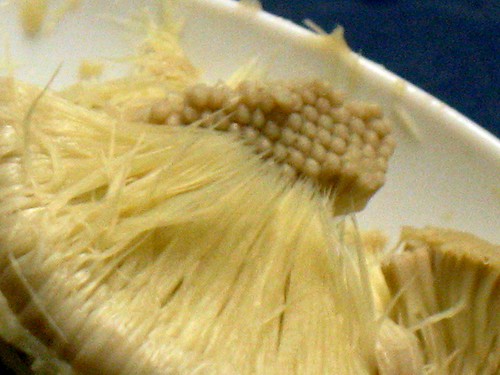
Remove the hairy bit...
Keep going like this, tearing of a leaf and eating the heel of it. As you get closer to the centre, the edible part of the leaf becomes larger. Once you have eaten away all the leaves, you are left with the heart. It looks exactly like a flower, with the petals torn off... which is what it is.

In the centre of the flower are all the pistils or stamens or whichever they are. Scoop those out with a spoon and throw them away. Now relish the best part of all: the heart. Oh bliss!!!

They make a great starter, by the way. One per person.

There are all sorts of other recipes out there for things to do with artichokes. My recommendation is to start with this one. The cooking process is about the same as for a mealie/ear of corn, and the testing  for readiness is pretty much the same, too.

Tuesday, 21 June 2011

Roast butternut and pine nut risotto

This is another one of those veggie dishes that are so good you don't find yourself thinking, "All this needs is a bit of meat, and it would be perfect." Even my carnivorous elder son wolfed it down and came back for seconds!

This recipe uses coriander leaves, but sage is just as good with butternut, so try that as a variation.

Oven temperature
200C

Ingredients
1 large butternut, peeled and cut into largish cubes
1 clove garlic, crushed
10ml fresh coriander leaves, chopped
Olive oil
30ml butter
1 onion, chopped
250ml arborio rice
250ml white wine
750ml vegetable stock
Pine nuts to serve
Parmesan cheese, grated, to serve

Method
  • In a large bowl, mix up about 25ml olive oil with the garlic and chopped coriander leaves.
  • Toss the butternut cubes in this until they are well coated, then place them on a baking tray in the oven for about 45 minutes until soft right through and just starting to darken along the edges.
  • Cut the cooked butternut into smaller cubes (when it is cool enough to handle, obviously!). Don't worry if some pieces get a little mushy. If any little bits got stuck to the baking tray, rescue them - you're going to want those babies in the risotto, too - they have a wonderful toffee-ish taste!
  • Heat 15ml of the butter and another 25ml oil in a  heavy-bottomed frying pan and saute the onion until it softens and becomes translucent.
  • Add the rice and stir until the grains are coated and shiny looking.
  • Add the wine and stir until the liquid has been absorbed.
  • Now add the stock. The proper way to do this is to add a little stock at first and then keep adding a little at a time as it is absorbed by the rice. I tend to just add the whole lot in one go... because I'm a lazy Philistine.
  • Simmer until done. Don't let the rice cook for too long - it is supposed to be al dente, like pasta.
  • Remove from the heat and stir in the butternut and the rest of the butter.
  • Place into serving bowls and top with a sprinkling of pine nuts, a little Parmesan cheese, a twist of black pepper and the rest of the coriander leaves.

Thursday, 16 June 2011

What do I do with...butternut (squash)?


In South Africa, this vegetable is known as butternut. In the UK, it is called butternut squash. I gather that Australians simply call it squash. Whatever it is called in your neck of the woods, this is one of my favourite vegetables.

When I was still 'living at home,' as the expression goes (as if after leaving your parents' house you are doomed to nomad-status for the rest of your life), it was a family tradition to make a special dinner on birthdays and the birthday girl (because ours was a single-sex family) got to choose what was on the menu. When it was my birthday, you could pretty much depend on it that you would be eating butternut and cauliflower (with white sauce). When I was a student, I would quite often survive on baked butternut for days at a time.

Butternut is more like pumpkin that squash in both texture and taste. It is firm-fleshed and has a slightly nutty taste.

So... butternut. What do we do with them?

Raw
Butternut can be grated into salads, although it can sometimes give you that feeling of furriness on the backs of your teeth. I do have a recipe for a salad that uses raw butternut, but I have never shared it because it also requires - believe it or not - powdered jelly (jell-o), which isn't readily available in the UK. However, fret not if you live in a country which oozes jelly powder from every pore and you are dying to try something new and different. Here it is, on someone else's site.

Cooked on the hob
There are various ways to cook butternut on the hob. You can
  • steam it on its own
  • steam it with chopped onion and/or coriander leaves
  • boil it (ditto the above two - and countless other - options)
  • make butternut soup with or without orange, with or without cauliflower, with or without coriander leaves and chilli. Here's Catherine's guest post recipe from a while ago.
  • make Malay-style cinnamon glazed butternut
Cooked in the oven
Butternut is also fab for
  • roasting - just do as you would do with potatoes, really. And once you've roasted it, you can use it for a different tasting soup, or for a scrumptious risotto.
  • baking - cut them in half, wrap in tin foil and bung 'em in the oven at about 200C until you can stick a sharp knife into it with ease. Alternatively, if you have plenty of time (or no foil), just chuck 'em in whole until they're done.
  • stuffing - cut the butternut in half, scoop out the pips and fill the hole with yummy things like chopped onion, bacon bits or whatever, then wrap with foil and bake as before. You can also fill the hollow after the butternut has been cooked with something like cheese sauce.
On the barbecue
One of my favourite things to do with butternut is to bake it in the coals of the barbecue - either halved and wrapped in tin foil or whole as is. You can stuff them if you like, just as you would for baking.

I'm sure there are endless other things you can do with this delicious and versatile vegetable, like substituting it for pumpkin in a traditional American pumpkin pie. But that should be enough to get you started.

Enjoy.

And feel free to share your own butternut ideas in the comments below, or on my Facebook page.

Tuesday, 14 June 2011

Chicken and sesame stirfry

I don't know about you, but I am mad-keen on the food at Wagamama. Unfortunately, on the last two occasions I visited my nearest branch, the service was iffy at best. On one occasion, it was so bad, that my husband called the manager over to complain... whereupon he (the manager, not my husband, although it was a close run thing) became belligerent and argumentative. Needless to say, my husband simply will not go back. I have since visited other branches and found the service to be of a better standard.

But I digress...

This dish has a flavour combination that reminds me of some Wagamama dishes. It's based on one that I downloaded from somewhere (Tesco diets, I think). It uses chicken breast fillets, but these are so ludicrously expensive in the UK, that I often substitute turkey breast.

Ingredients
2 large skinless chicken breast fillets, sliced into thin strips
1 tablespoon honey
Juice of 1 lime
2 kaffir lime leaves (optional), finely shredded
1 tablespoon toasted sesame seeds (you can toast these yourself, if you can't buy toasted ones)
1 tablespoon olive oil
1 clove garlic, peeled and crushed
5cm piece root ginger, peeled and finely chopped
225g broccoli florets
2 large carrots (you may notice from the picture that I threw in a courgette, too)
1 bunch spring onions, trimmed
250g noodles
1 tablespoon teriyaki sauce
1 tablespoon soy sauce

Method
  • Mix together the olive oil, ginger, lime leaves (if using) and garlic in a bowl.
  • Add the chicken strips, toss to mix and set aside until needed.
  • Blanch the the broccoli florets as follows: place them in a heatproof bowl, cover with boiling water and leave to stand for 1 minute. Drain, refresh under cold, running water and drain well.
  • Cut carrots into matchstick strips (you may notice from the picture that I was lazy on this!)
  • Cut the spring onions in half lengthwise and then again crosswise.
  • Heat a wok or a large frying pan and then add the chicken and stirfry for 2 minutes.
  • Add the carrots, onions and broccoli and just a little water. Cover with a lid and steam for about 5 minutes (make sure chicken is cooked through).
  • Cook the noodles as per instructions on the packaging.
  • Mix together teriyaki sauce, soy sauce, lime juice and honey.
  • Drain the noodles and add to the chicken.
  • Add the liquid mixture.
  • Toss well until everything is evenly distributed and hot.
  • Sprinkle sesame seedds over the top. Serve.
On the occasion when the photo was taken, I used quinoa instead of noodles, just for a change. It worked. Of course.

Thursday, 9 June 2011

What do I do with beetroot (beets)?

Welcome to the first in my new series, "What do I do with...?"

I have discovered that a great many accomplished people are at a loss as to how to prepare fresh ingredients, and I thought I'd have a go at doing something about that. I decided to start with beetroot because it is so versatile and because it falls somewhere between the everyday things like carrots and cabbage and the 'outlandish' things like fennel and edamame beans.

It is not my intention to provide an exhaustive list in each instance, and I won't always supply links to recipes. But at least you will have a few ideas to set you off on a Google quest.

If you have any special requests, please let me know.

Back to beetroot.

Raw
You may not know this, but you can eat beetroot raw.
  • Peeled and grated into a fresh salad, it adds colour, interest, texture... and vitamins!
  • There are also some delicious cake recipes that call for raw beetroot

Boiled
If you're going to boil a beetroot, don't peel it, but cut the stems off about an inch away from the veg itself, this prevents too much of the colour from leeching away during cooking. Boil for about as long as you would a potato of similar size. When you can insert and remove a sharp knife without too much hassle, it's done. Now you can peel it and do any of a number of things with it.
  • You could serve it hot as a vegetable with your main meal
  • You could chop it up and use it in a risotto
  • You could wait for it to cool down and slice or shop it up into a salad
  • You could slice it and pickle it
  • On the other hand, there are also cake recipes that call for cooked beetroot
Roast
One of my favourite things to do with beetroot is to roast it along with other veg. Peel and quarter the raw beetroot and roast it in the oven, just as you would a potato. It takes a little longer, though, so test it with a sharp knife for readiness. You can also sprinkle cumin, fennel, coriander or caraway seeds over it before roasting. Yum!

So, off you go, now and experiment with this delicious, nutritious vegetable. I should just warn you though, that the colour erm... "goes straight through you" (as my mother-in-law puts it) so you might notice evidence of it on your subsequent visit to the loo (bathroom) for a day or so. Do not panic.

Later edit:
Doh! And I completely forgot to mention that you can use it to make borscht (traditional Russian soup)!

Thursday, 19 May 2011

Cinnamon glazed butternut

When I was a child, my Afrikaans granny had a tendency to cook with a lot of sugar. So did a lot of Afrikaans ladies of that vintage. It was just 'the way it's done'. And I'm not talking about cakes and sweets. I'm talking about vegetables. A spoon of sugar in the green peas. A teaspoon of sugar and a teaspoon of butter in each half of a gem squash (a tennis ball sized squash that looks like this) as it was placed on the plate. Sugar in this, sugar sprinkled over that. Astonishingly she and my grandfather both lived into their 80s.

I loved my Gran's cakes, but I was never a fan of her vegetables. I have never been much of a one for adding sugar to the deliciously natural sweetness of vegetables.

With one occasional exception.

Every now and again, when I am cooking a bobotie or a biryani, I make cinnamon glazed butternut to go with it. It is utterly, utterly sinful. But I am not advocating that this recipe should take the place of the way you normally cook your butternut.

Oh... and it works just as well with pumpkin. I just prefer the taste of butternut.

Ingredients
125ml cold water
500g butternut, peeled and cut into thick pieces
30ml butter
5ml ground cinnamon
10ml soft brown sugar

Method
  • Pour the water into a heavy-based saucepan first.
  • Spread the butternut over the base of the saucepan in no more than two layers.
  • Sprinkle the sugar and cinnamon evenly over the butternut.
  • Dot the butter on top.
  • Cover and cook over a low heat until the butternut is soft (about 20 minutes or so). Keep an eye on the water level. If the water all boils away, the butternut will burn.

Thursday, 24 February 2011

Roast beetroot with rotmos


I had been married to my Swede for many years before I finally got to visit Sweden for the first time. His family hails from a tiny island off the west coast of the country, where we had a large 'gathering of the clans' the year my husband turned 40. Not purely because it was his 40th, but also because that was the year his sister turned 50, his cousin turned 40 and his Mom turned 75. I think there were a few other big events that year, but I can't remember what they were... which is a little sad, because we are now exactly 10 years down the line, which means we're in for another round of them!

Anyhoo, while we were there, my in-laws rustled up a meal that has since become a regular on my table: smoked sausages with beetroot and rotmos (root mash). So today, you get two recipes in one. Mainly because they aren't really 'recipes', strictly speaking.

On that occasion, they simply boiled the beetroot, and ate them with far too much butter. You could try that... only it's probably a good idea to cut back on the butter! I often roast a variety of vegetables together: potatoes, carrots, parsnips, bell peppers, beetroots and onions. You could try that, too.

But today, it's just the beetroots on their own. And this is how you do it.

Oven temperature
180C

Peeled and quartered
Ingredients
Beetroot, one per person, peeled and quartered
A little oil
Some fennel or cumin seeds (optional)

Method
  • Preheat the oil in a roasting dish.
  • Place the beetroot quarters in the hot oil and sprinkle with a few seeds (if you're using these).
  • Roast until done (about 40 minutes), turning every 10 minutes or so.

While that's happening, let's get cracking on the rotmos. This is made on the hob.

Ingredients
Boil together
Potatoes, one per person, peeled and cubed
Carrots, one per person, peeled and chopped
Swede (rutabaga), one small, or half a medium sized one, peeled and cubed
Butter, milk and salt (optional)
  • Boil up the vegetables together until they're soft.
  • Mash them all up together, using a little butter, milk and salt to get it just the way you like it.

Serve with the roast beetroot and smoked sausage. Of course, if you're a vegetarian, you could just leave out the sausage, or replace it with a veggie option.

Thursday, 10 February 2011

Roast parsnips


Don't be alarmed by that white substance between the parsnips in the photo. All will be revealed...

All the years I lived in South Africa, I had no idea what a person would do with a parsnip. Their Afrikaans name (witwortels) translates to 'white roots' (mind you, carrots are simply called 'roots' in Afrikaans, so it's hardly surprising), which I didn't find helpful. I never bought them, because I had no idea how to prepare them, and because I had the weird notion that they would taste like turnips, which I don't enjoy. The only time I ever consumed them was when my sister in law grated them into a soup, which of course gave me no indication as to how they would taste alone.

One of the 'bank staff' members at my very first job in the UK was appalled to discover this gaping hole in my culinary experience, and shared her recipe with me. I wish I could remember her name. Mea culpa... but we didn't work together very long.

I have since discovered there are a great many things you can do with a parsnip, but this remains my favourite, so I share it with you. My husband says 'they're like sweeties', my elder son snarfs them with relish, but my younger son is not a fan. His girlfriend is mad about them, however, but never gets them at home, so we kidnap her for dinner if I'm ever making them.

Oven temperature
180-200C

Ingredients
Parsnips (as many as you need)
Cornflour
Parmesan
Cumin seeds (optional - these were not part of the original recipe)
Oil

Method
Coated and sprinkled
  • Peel the parsnips and cut them into large pieces (I usually cut them in half across the middle and then cut the fatter top part in half again, vertically)
  • Steam them over boiling water for about 5 minutes until they are just starting to soften.
  • While the parsnips are steaming, preheat some oil in your roasting pan in the oven.
  • Make a half-and-half mixture of cornflour and grated Parmesan and coat each piece of parsnip in this. I usually use a Tupperware lunch box, in which I gently shake the parsnips one at time (it only takes a few seconds for each one).
  • Pop the parsnips into the preheated oil in the roasting pan and sprinkle each one with a few cumin seeds.
  • Roast for about 20 minutes, turning occasionally, until golden on all sides. They should crisp up nicely.
  • Don't feel you can only serve these with a roast joint. They are utterly delicious with pork chops, steak, grilled chicken.... you name it!

Tuesday, 8 February 2011

Barbara's crustless savoury tart


This is one of my Mom's recipes. I realise she hasn't had much of a look-in on this blog so far. This is partly because she only came to enjoy cooking in her retirement, by which time I had long since left home. My Mom had the disadvantage of being the daughter of a good cook and then the daughter-in-law of an even better cook (nothing my Mom ever made was good enough for my Dad).

After my parents split up, my Mom was a single parent, working full time. Cooking was something to be done as quickly and easily as possible each evening after work, in order to get the kids fed on a severely limited budget. Our meals tended to be very ordinary.

These days, my Mom is much more daring. This recipe dates back to my teens. Back then, it was quite adventurous by my Mom's standards.

Double recipe, single dish
The recipe makes two tarts. You can halve it, of course. When I made it on this occasion, I put the whole double recipe into a single large pyrex dish and it worked just fine. I didn't even increase the time (but then, I have a fan-assisted oven, which makes a significant difference).

Oven temperature
180C

Ingredients
250g bacon, chopped
1 onion, chopped
2 thick slices of bread (about 2cm), crusts removed
625ml milk
30ml butter/marg
6 eggs
500ml grated cheese (mature cheddar works well)
1 tin corned beef (aka bully beef), mashed/chopped
5ml chopped parsley and/or chives
5ml English or Dijon mustard (optional - I leave this out)
salt and pepper to taste

Method
  • Fry the bacon and onion together lightly. You shouldn't need oil - there is enough fat in bacon.
  • Place the bread, milk and butter into a saucepan and boil gently for 5 minutes.Mash the bread and leave to cool.
  • Beat the eggs in a large bowl.
  • Stir in the cheese, bacon and onion, bread and milk mixture.
  • Add remaining ingredients.
  • Pour into two pie plates and bake for 30 minutes until the egg has set.
  • Eat hot or cold with salads.
Notes:
Try using different meats. Frankfurters work really well, and if you have a few slices of ham left over from making the kids' sandwiches, chuck them in, too.
You could also try it with vegetables. It's a great way to deal with a few leftover vegetables. Broccoli works brilliantly, as do peas, grated carrot and chunks of potato. Just cook them lightly first.

Tuesday, 11 January 2011

Butternut soup


I am the queen of soups. Or so I like to think, anyway! But that wasn't always the case. I used to think that soups were about the scariest things imaginable to try to make. Looking back, now, I don't know what all the fuss was about - it's as easy as... in fact, considerably easier than pie.

I love a nice warming soup on a cold winter's night, and am quite happy to have it as a meal, not just a starter. Although, as a concession to the hefty appetites of my sons, soup for main course always means that there will be dessert.

Unusually for England, I have no qualms about inviting people over for 'soup and rolls'. Granted, these evenings usually involve a choice of three soups, fresh baked rolls, dessert, a few games of Chüngel, a lot of chatter, and almost as much laughter, but dinner invitations in the UK usually involve rather more upscale fare.

As you can see, the picture accompanying this post is well over three years old. It was taken when my elder son was studying food technology at school and chose to make this dish for one of his practicals. Perhaps the fact that it was made single-handedly by a teenage boy will embolden you to try it, even if you've never made a soup in your life.

One small inconvenience about this recipe is that it works best if you have a blender. But I promise to share other recipes that don't need extraneous electrical equipment.

Ingredients
1 large butternut squash
1 or 2 onions (this is a taste issue - why not experiment until you get the balance you prefer?)
Chicken and/or vegetable stock - enough to cover the vegetables when peeled and chopped
Salt
Coriander leaves
Plain pouring yoghurt
Mild curry powder

Method
  • Peel, de-seed and cube the butternut into chunks of about 2.5cm
  • Finely chop the onion
  • Pop all of these into a saucepan/pressure cooker and cover with stock
  • Add about 5-10mls of salt (see note below)
  • Boil until the butternut is very soft and the onions absolutely done.
  • Finely chop about a loose handful of coriander leaves and add at this point
  • Blend the mixture (including the liquid) until completely smooth - if you have a food processor type blender and have to blend the soup in shifts, this might take a while, so you might need to reheat the soup afterwards. Do this gently.
  • You might need to add liquid (water, stock, milk, cream - your choice) if the soup is too thick, but you are aiming for a fairly thick consistency, here.
  • When you serve, pour a little plain yoghurt into the centre of each bowl and give it one little swirl. It tastes great and looks attractive. Sprinkle a little mild curry powder in the centre of the swirl and add a bit more fresh, chopped coriander (and/or a sprig)
  • Serve with warm bread rolls
Variations
  • Try adding carrots and/or parsnips before cooking
  • Stir in the grated zest of an orange or a lime before blending
A note about salt:
These days, we are all being warned about excessive salt intake. I have a fairly light hand when it comes to salt, but I find I add more salt to soups than to anything else I make.

Remember: It's easier to fix an undersalted dish than an oversalted one. You can always add more salt after cooking if you need to. If you oversalt, one trick is to throw a whole potato into the dish and cook it for a little longer. The potato absorbs some of the salt, but this won't work very well with a blended soup recipe like today's.

If you are a salt lover, and you're conscious that you should try to cut down, try some of the low sodium options, or use herbs to add flavour.

Monday, 10 January 2011

Hasselback potatoes


Sadly, there is no lovely family history attached to this recipe - it came out of a magazine at some point. But I'm making them tonight to go with a roast chicken (yes, on a Monday night - where is it written that I can't make a roast on a school night?), and they are seriously yummy, so I thought I'd share. They make a great alternative to roast potatoes and are considerably lower in calories and fat content.

Ingredients
Potatoes - preferably the long, skinny kind (as many as you think you'll need)
500ml stock
200ml white wine
Bay leaves

Oven temperature
200C

Method
  • Peel the potatoes. If you weren't able to get the long skinny ones, cut them in half lengthwise.
  • Make several narrow slices into each one. In order to avoid cutting all the way through, stick a skewer through each one first, about 1cm from the bottom and cut down to that.
  • Stick a bay leaf into one cut on each potato
  • Pour stock and wine into an oven pan
  • Place the potatoes into the pan
  • Drizzle with olive oil
  • Bake for about 50 minutes, basting from time to time.
You can add any remaining stock to your gravy.